

Why Preventive Dental Care Saves You Time and Money
July 24, 2025
Straighten Your Smile Without Braces: Clear Aligner Options
August 20, 2025
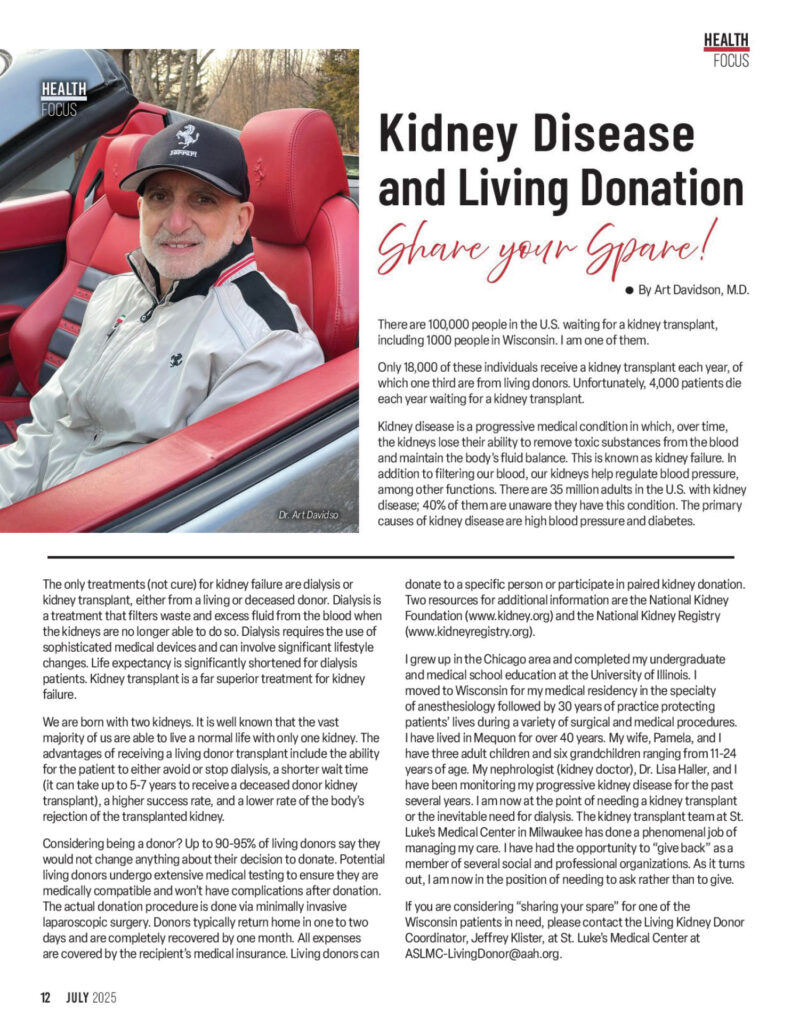
by Art Davidson, M.D.
There are 100,000 people in the U.S. waiting for a kidney transplant, including 1000 people in Wisconsin. I am one of them.
Only 18,000 of these individuals receive a kidney transplant each year, of which one third are from living donors. Unfortunately, 4,000 patients die each year waiting for a kidney transplant.
Kidney disease is a progressive medical condition in which, over time, the kidneys lose their ability to remove toxic substances from the blood and maintain the body’s fluid balance. This is known as kidney failure. In addition to filtering our blood, our kidneys help regulate blood pressure, among other functions. There are 35 million adults in the U.S. with kidney disease; 40% of them are unaware they have this condition. The primary causes of kidney disease are high blood pressure and diabetes.
The only treatments (not cure) for kidney failure are dialysis or kidney transplant, either from a living or deceased donor. Dialysis is a treatment that filters waste and excess fluid from the blood when the kidneys are no longer able to do so. Dialysis requires the use of sophisticated medical devices and can involve significant lifestyle changes. Life expectancy is significantly shortened for dialysis patients. Kidney transplant is a far superior treatment for kidney failure.
We are born with two kidneys. It is well known that the vast majority of us are able to live a normal life with only one kidney. The advantages of receiving a living donor transplant include the ability for the patient to either avoid or stop dialysis, a shorter wait time (it can take up to 5-7 years to receive a deceased donor kidney transplant), a higher success rate, and a lower rate of the body’s rejection of the transplanted kidney.
Considering being a donor? Up to 90-95% of living donors say they would not change anything about their decision to donate. Potential living donors undergo extensive medical testing to ensure they are medically compatible and won’t have complications after donation. The actual donation procedure is done via minimally invasive laparoscopic surgery. Donors typically return home in one to two days and are completely recovered by one month. All expenses are covered by the recipient’s medical insurance. Living donors can donate to a specific person or participate in paired kidney donation. Two resources for additional information are the National Kidney Foundation (www.kidney.org) and the National Kidney Registry (www.kidneyregistry.org).
I grew up in the Chicago area and completed my undergraduate and medical school education at the University of Illinois. I moved to Wisconsin for my medical residency in the specialty of anesthesiology followed by 30 years of practice protecting patients’ lives during a variety of surgical and medical procedures. I have lived in Mequon for over 40 years. My wife, Pamela, and I have three adult children and six grandchildren ranging from 11-24 years of age. My nephrologist (kidney doctor), Dr. Lisa Haller, and I have been monitoring my progressive kidney disease for the past several years. I am now at the point of needing a kidney transplant or the inevitable need for dialysis. The kidney transplant team at St. Luke’s Medical Center in Milwaukee has done a phenomenal job of managing my care. I have had the opportunity to “give back” as a member of several social and professional organizations. As it turns out, I am now in the position of needing to ask rather than to give.
If you are considering “sharing your spare” for one of the Wisconsin patients in need, please contact the Living Kidney Donor Coordinator, Jeffrey Klister, at St. Luke’s Medical Center at ASLMC-LivingDonor@aah.org.